The Towns Nobody Saw Coming: How Princeton, Celina, and Fulshear Are Reshaping Heavy Equipment Demand in Texas
Seven of the fifteen fastest-growing cities in America are in Texas right now. For the shops and operators keeping construction moving in these corridors, the opportunity — and the pressure — is unlike anything seen in a generation.
Talox Editorial
Industry Intelligence Desk
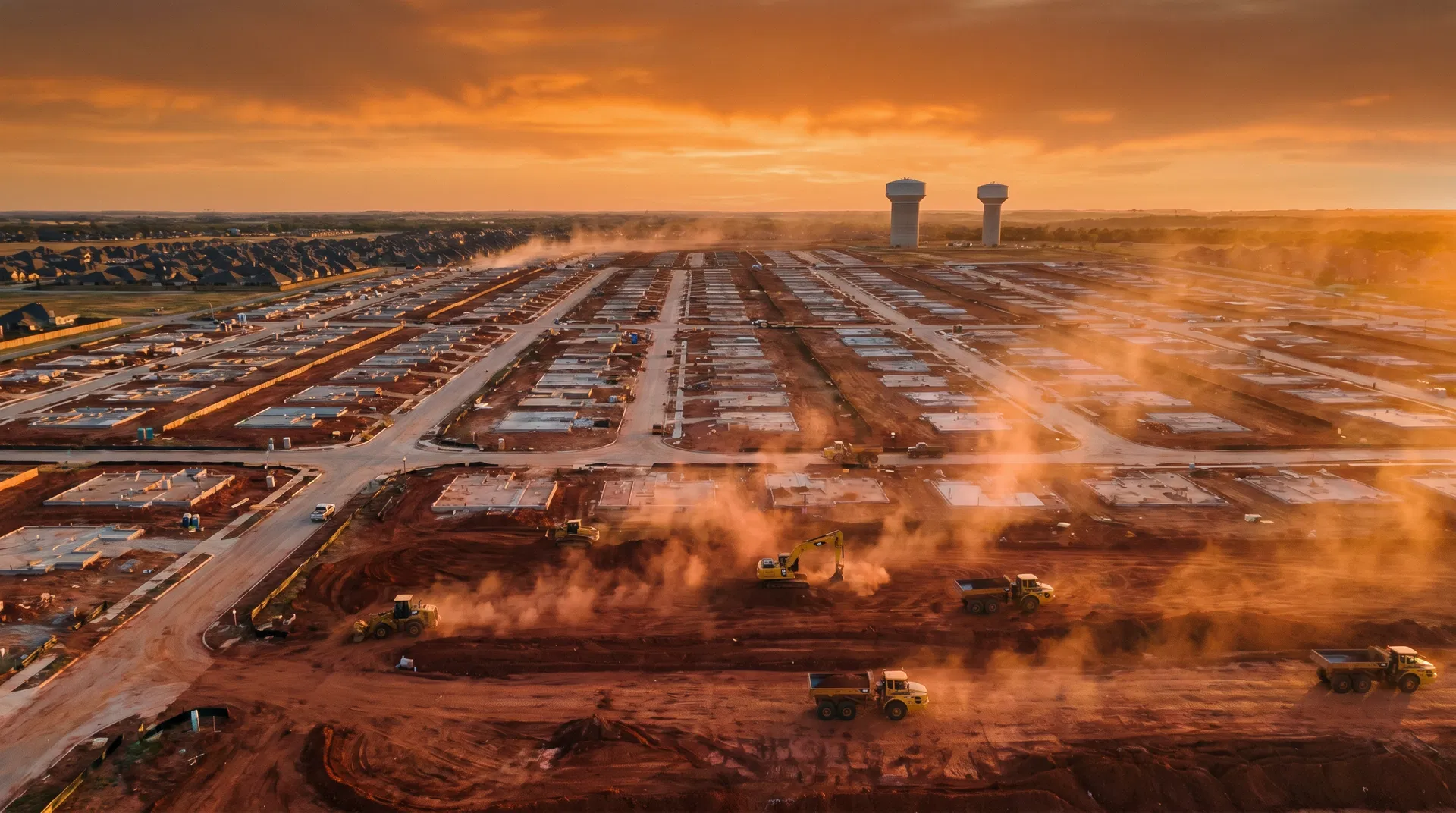
The Towns Nobody Saw Coming
If you drive north out of Dallas on US-75 on a Tuesday morning, you will pass through McKinney, then Allen, and eventually hit a stretch of road where the landscape shifts abruptly from established suburb to raw earth. Cranes punctuate the horizon. Concrete trucks queue at intersections that didn't exist three years ago. Welcome to Princeton, Texas — the fastest-growing city in the United States.
According to the U.S. Census Bureau's Vintage 2024 population estimates, Princeton grew by 30.6 percent in a single year, adding nearly 8,500 residents to reach a population of 37,019. That number understates the physical reality on the ground. Every new resident requires roads, water lines, sewer connections, electrical conduit, and eventually the commercial infrastructure — grocery stores, gas stations, medical offices — that follows residential growth. Every one of those projects runs on heavy equipment.
Princeton is not alone. Fulshear, a Houston suburb in Fort Bend County, grew 211 percent between 2020 and 2025, from 17,558 residents to 54,629. Celina, straddling Collin and Denton counties north of Frisco, grew 190 percent over the same period. Anna, Fate, Melissa, Hutto, Josephine, Liberty Hill, Royse City — the list reads like a roll call of places that most Texans couldn't have located on a map a decade ago.
Together, these cities are creating what infrastructure analysts describe as a compounding demand cycle. Multiple high-growth municipalities within a tight geographic radius allow contractors to optimize crew deployment and equipment utilization in ways that isolated boom towns never permit. A shop in McKinney or Georgetown that has built relationships with the contractors working these corridors is not just busy — it is structurally busy, with a backlog that self-replenishes as each new subdivision phase kicks off.
What Growth Actually Looks Like for Equipment
The infrastructure math behind residential growth is straightforward but often underappreciated. A single master-planned community of 2,000 homes requires approximately 15 to 20 miles of underground utility installation, 8 to 12 miles of new roadway, and hundreds of thousands of cubic yards of earthwork. That work is performed by excavators, motor graders, compactors, trenching machines, and articulated dump trucks — all of which accumulate hours at an accelerated rate when projects run back-to-back with minimal downtime.
The Texas Department of Transportation's 2025 Unified Transportation Program commits $104 billion over ten years to construction and maintenance projects statewide, with a disproportionate share concentrated in the DFW and Houston metro areas. The $146 billion in additional highway spending announced by Governor Abbott in late 2025 further reinforces the structural nature of this demand. This is not a cycle. It is a decade-long infrastructure buildout.
For heavy equipment repair shops operating in or near these growth corridors, the implications are direct. Equipment that would normally accumulate 1,000 hours over an eighteen-month period may be logging that same usage in eight or nine months on active development sites. Maintenance intervals compress. Hydraulic systems, undercarriage components, and engine filters reach service thresholds faster. The shops that understand this rhythm — and that have positioned their parts inventory and technician capacity accordingly — are the ones fielding calls at 6 a.m. from contractors who cannot afford a machine sitting idle.
The Affordability Gradient and What It Tells You
One of the more useful analytical frames for understanding where the next wave of growth will land is the affordability gradient. Princeton's median home price sits around $325,000, compared to $500,000 in McKinney and $685,000 in Frisco. As the inner suburbs price out middle-income buyers, demand flows outward to the next ring — and the ring after that.
Celina at $380,000 median is already absorbing overflow from Frisco. Anna at $340,000 is absorbing overflow from McKinney. The pattern is self-replicating: as each outer suburb matures and prices rise, the frontier moves further out. For shops tracking where to position service capacity, the affordability map is a leading indicator of where equipment hours will accumulate over the next three to five years.
The same dynamic is playing out in the Houston metro, where Fulshear's explosive growth reflects the westward expansion of buyers priced out of Sugar Land and Katy. In the Austin metro, Hutto and Liberty Hill are absorbing the overflow from Round Rock and Cedar Park. Georgetown, which added nearly 46,000 residents between 2020 and 2025, now ranks as the city with the largest absolute population gain of any U.S. city over that period.
A Note on the Suburbs Nobody's Talking About Yet
The cities getting the headlines — Princeton, Fulshear, Celina — are already on every contractor's radar. The more interesting conversation, from a forward-looking perspective, is about the second tier: Josephine, Caddo Mills, Royse City, Forney. These communities are growing at rates between 10 and 18 percent annually, but they are doing so from smaller bases, which means the infrastructure buildout is still in its early phases.
Caddo Mills in Hunt County grew 17.6 percent in a single year. Josephine in Collin County grew 18.5 percent. These are not footnotes — they are the next Princeton. The contractors who are already working those corridors, and the shops that are already servicing those contractors, are building relationships that will compound in value over the next decade.
Texas is not just growing. It is growing in a pattern that is legible, data-driven, and — for those paying attention — remarkably predictable. The machines doing the work need to be maintained. The shops maintaining those machines are, in a very real sense, the infrastructure behind the infrastructure.
Tags
Ready to take control of your AR?
Start your free trial and see how Talox automates collections, syncs your platforms, and keeps cash flowing.
Get the next article in your inbox
Join shop owners and mechanics who get Talox industry insights, data reports, and field guides — no sales pitches, just the good stuff.
No spam. Unsubscribe anytime.
More in Industry Insights
The Outskirts Are Open for Business: How the Suburban Sprawl Is Creating a New Kind of Equipment Operator
6 min read
OEM vs. Aftermarket: The Honest Conversation Your Parts Vendor Doesn't Want You to Have
6 min read
Georgia and Florida: Two Markets, Two Stories, One Big Opportunity for Heavy Equipment Shops
7 min read