OEM vs. Aftermarket: The Honest Conversation Your Parts Vendor Doesn't Want You to Have
The price difference between OEM and aftermarket parts can be significant. So can the difference in outcomes. Here's a framework for making the call on a job-by-job basis — without ideology getting in the way.
Talox Editorial
Industry Intelligence Desk
OEM vs. Aftermarket: The Honest Conversation
Few topics in the heavy equipment repair world generate more heat and less light than the OEM versus aftermarket debate. On one side, you have the OEM dealers who will tell you that genuine parts are the only responsible choice, that aftermarket components void warranties, and that the cost savings are illusory when you factor in the reduced service life. On the other side, you have the aftermarket suppliers who will tell you that their components are manufactured to the same tolerances as OEM parts, that the price premium is pure brand markup, and that smart shops have been saving their customers money with aftermarket parts for decades.
Both sides are telling you part of the truth. Neither is telling you all of it.
Where Aftermarket Makes Sense
The case for aftermarket parts is strongest in three categories: filters, wear items, and components for older machines.
Filters — oil filters, fuel filters, hydraulic filters, air filters — are the clearest case. The filtration media and construction of quality aftermarket filters from established suppliers are functionally equivalent to OEM filters for the vast majority of applications. The price difference can be 30 to 50 percent. For a shop that goes through hundreds of filters per month, this is a meaningful cost reduction that flows directly to the customer.
Wear items — cutting edges, bucket teeth, track pads, wear plates — are similarly straightforward. These are components that are consumed by the work the machine does, and the relevant performance metric is wear life per dollar, not brand provenance. Quality aftermarket wear items from reputable suppliers often perform comparably to OEM at a significant cost savings.
For older machines — anything more than ten years old — the aftermarket case strengthens further. OEM parts availability for older equipment can be spotty, lead times can be long, and the price premium for genuine parts on a machine with 15,000 hours on it is harder to justify. The aftermarket ecosystem for older Caterpillar, Komatsu, and Deere equipment is deep and well-established.
Where OEM Is Worth the Premium
The case for OEM parts is strongest in three different categories: precision components, warranty-sensitive situations, and critical safety systems.
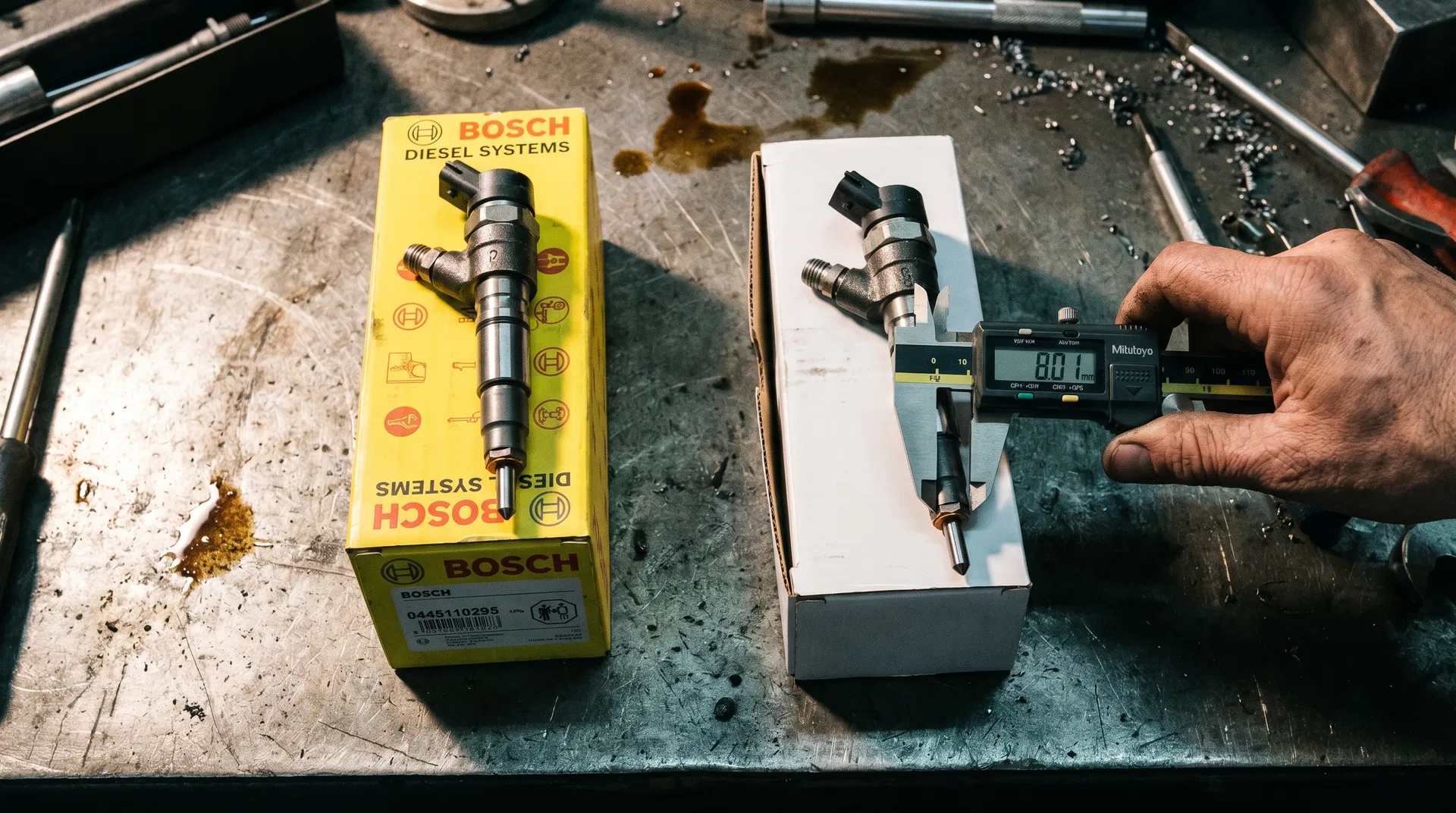
Precision components — fuel injection systems, hydraulic pump internals, electronic control modules — are where the manufacturing tolerances matter most. The performance of a fuel injector is determined by clearances measured in microns. An aftermarket injector that is slightly out of spec will not fail immediately; it will degrade engine performance gradually and may cause downstream damage that costs far more than the initial savings. For these components, the OEM premium is buying manufacturing precision that is difficult to verify from the outside.
Warranty-sensitive situations are another clear case for OEM. If a machine is still under manufacturer warranty, using non-OEM parts in a repair can void the warranty coverage for that system. The math on this is simple: the value of the remaining warranty coverage almost always exceeds the cost difference between OEM and aftermarket parts.
Critical safety systems — brakes, steering components, structural welds — are not the place to optimize for cost. The liability exposure from a safety-related failure that can be traced to a non-OEM part is not a risk that any shop should be willing to take.
The Framework
A practical framework for making the OEM versus aftermarket decision on a job-by-job basis involves three questions. First: is this component precision-critical, warranty-sensitive, or safety-related? If yes, use OEM. Second: is this a filter, wear item, or component for an older machine? If yes, quality aftermarket is likely appropriate. Third: does the customer have a strong preference? If yes, honor it — the customer relationship is worth more than the cost difference.
The shops that navigate this well are the ones that have established relationships with two or three quality aftermarket suppliers and know which product lines they trust. They are not using the cheapest available aftermarket part for every application — they are using quality aftermarket parts where the performance and reliability are well-established, and OEM where the stakes are highest.
The Vendor Conversation
One of the more valuable conversations a shop can have with its parts vendors — both OEM dealers and aftermarket suppliers — is about the specific product lines where the vendor has the most confidence in their quality. An OEM dealer who is honest with you will acknowledge that some of their product lines have more robust aftermarket competition than others. An aftermarket supplier who is honest with you will tell you which of their product lines they would use on their own equipment and which ones they would not.
These conversations require a level of trust that takes time to build. But they are worth having, because the information you get from a vendor who is being straight with you is more valuable than any catalog or price sheet.
Tags
Ready to take control of your AR?
Start your free trial and see how Talox automates collections, syncs your platforms, and keeps cash flowing.
Get the next article in your inbox
Join shop owners and mechanics who get Talox industry insights, data reports, and field guides — no sales pitches, just the good stuff.
No spam. Unsubscribe anytime.
More in Industry Insights

The Outskirts Are Open for Business: How the Suburban Sprawl Is Creating a New Kind of Equipment Operator
6 min read

The Towns Nobody Saw Coming: How Princeton, Celina, and Fulshear Are Reshaping Heavy Equipment Demand in Texas
7 min read

Georgia and Florida: Two Markets, Two Stories, One Big Opportunity for Heavy Equipment Shops
7 min read