The Outskirts Are Open for Business: How the Suburban Sprawl Is Creating a New Kind of Equipment Operator
The construction frontier in Texas has moved beyond the suburbs and into the exurbs. The operators and shops working these corridors are building something more than roads and subdivisions — they're building the next generation of the industry.
Talox Editorial
Industry Intelligence Desk
The Outskirts Are Open for Business
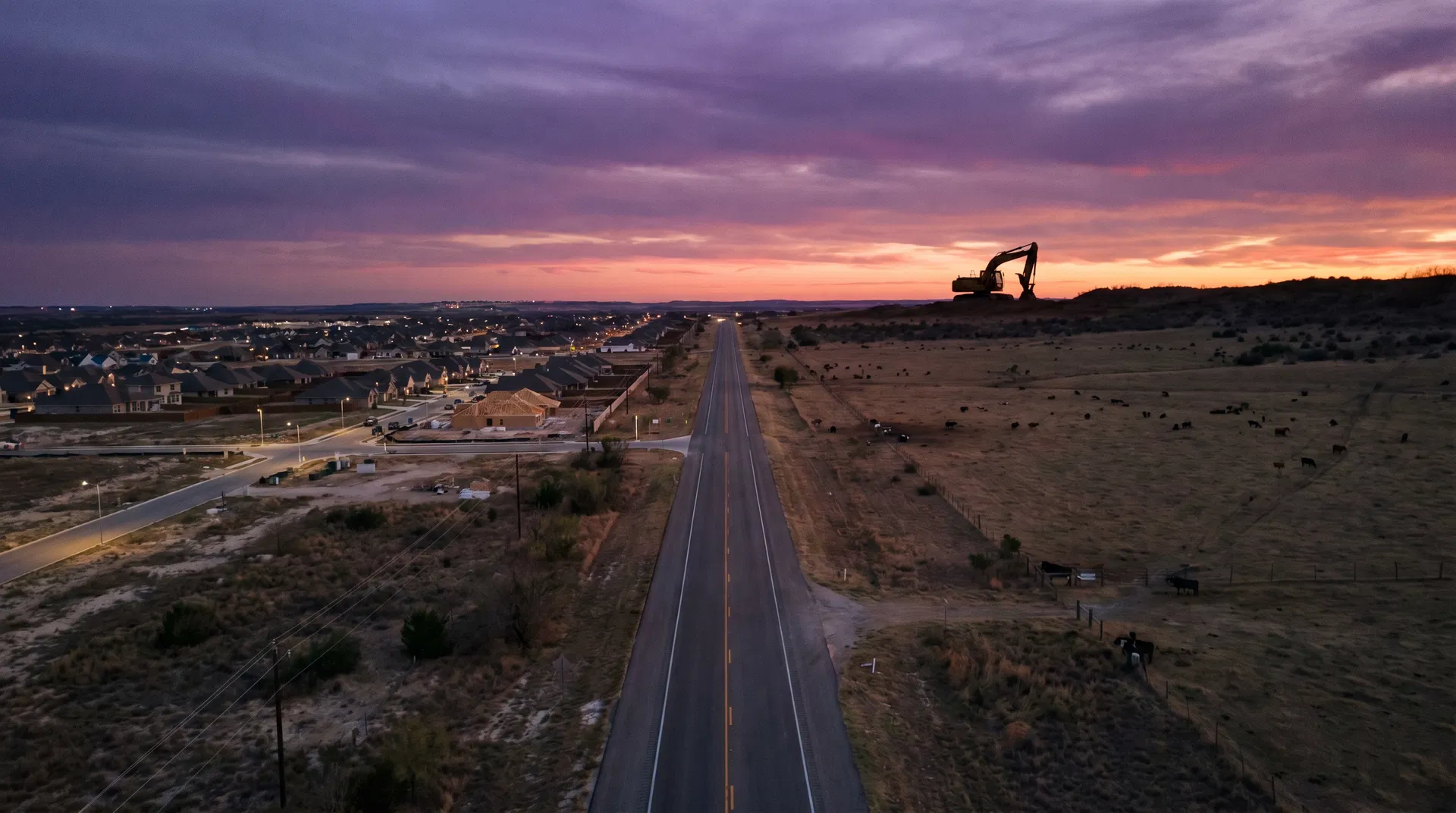
There is a particular kind of morning that happens in Josephine, Texas, and in Caddo Mills, and in Liberty Hill, and in a dozen other towns that most people in the construction industry have not yet added to their mental map. The sun comes up over raw earth. The air smells like diesel and turned soil. The machines are already running.
These are the towns at the edge of the Texas growth frontier — the places where the affordability gradient that has been pushing population outward from Dallas, Houston, and Austin has finally arrived. Josephine, in Collin County, grew 18.5 percent in a single year. Caddo Mills, in Hunt County, grew 17.6 percent. Liberty Hill, in Williamson County northwest of Austin, grew 17.5 percent. These are not rounding errors. These are communities in the early stages of the same transformation that turned Frisco from a small town into a city of 200,000 people.
The Infrastructure Gap
The challenge with fast-growing exurban communities is that the infrastructure always lags the population. Roads that were adequate for a town of 2,000 are not adequate for a town of 10,000. Water and sewer systems that served a small community need to be expanded, upgraded, and in some cases entirely replaced. The electrical grid needs reinforcement. Drainage systems need to be redesigned for the increased impervious cover that comes with development.
All of that work requires heavy equipment, and it requires it now — not when the infrastructure planning process catches up with the growth, but in the immediate term, as communities scramble to keep basic services functioning for the new residents who are already there.
This infrastructure gap is one of the defining characteristics of the current Texas growth cycle. The DFW metroplex alone has $8.2 billion in infrastructure investment planned for 2024 and 2025. The Houston metro has $4.1 billion. The Austin metro has $3.8 billion. These are not hypothetical numbers — they are committed projects, many of which are already in the ground.
The New Equipment Operator
The construction boom in the Texas exurbs is creating a new generation of equipment operators, and they are different from the operators who built the previous generation of suburbs. They are younger, on average. Many of them came to the industry during the pandemic, when construction was one of the few sectors that kept running. Some of them learned on YouTube before they learned in a cab. Many of them are running machines that are connected to telematics systems that track their every move.
This new generation of operators has different expectations of the shops that service their equipment. They expect communication — text updates, digital invoices, online payment. They expect transparency about what was done and why. They expect to be able to look up the service history of their machine without calling the shop. And they expect the shop to know their machine — not just the make and model, but the specific unit, its history, its quirks.
Shops that are still operating on paper tickets and phone calls are going to find it increasingly difficult to serve this customer. Not because the new operators are demanding — they are not, in general, any more demanding than the previous generation. But because the baseline expectation of what a professional service relationship looks like has shifted, and shops that are not meeting that baseline are going to find themselves losing customers to shops that are.
The Community Dimension
One of the things that makes the exurban construction boom different from the suburban booms that preceded it is the community dimension. In Josephine and Caddo Mills and Liberty Hill, the contractors and operators and shop owners are not anonymous participants in a large metropolitan economy. They are members of a community that is small enough that everyone knows everyone.
This creates a different kind of business relationship. The shop owner who sponsors the Little League team, who shows up at the city council meeting when road maintenance is on the agenda, who knows the names of the contractors' kids — that shop owner has a relationship with their customers that goes beyond the transactional. It is a community relationship, and it is one of the most durable forms of customer loyalty that exists.
The shops that are building these relationships in the current growth cycle are positioning themselves for the long term. The exurbs of today are the suburbs of tomorrow. The contractors and operators who are working these corridors now are going to be the established players in these communities for the next twenty years. The shops that are their partners today are going to be their partners for the long term.
What This Means for the Industry
The Texas exurban growth cycle is not a temporary phenomenon. It is the leading edge of a structural shift in where Americans live and work — a shift that is being driven by remote work, by housing affordability, and by the fundamental human preference for space. The communities at the frontier of this shift are going to need infrastructure, and that infrastructure is going to need to be built and maintained by heavy equipment.
For the shops and operators who are paying attention, the opportunity is clear. The frontier is open. The work is there. The question is who is going to be ready to do it.
Tags
Ready to take control of your AR?
Start your free trial and see how Talox automates collections, syncs your platforms, and keeps cash flowing.
Get the next article in your inbox
Join shop owners and mechanics who get Talox industry insights, data reports, and field guides — no sales pitches, just the good stuff.
No spam. Unsubscribe anytime.
More in Industry Insights
OEM vs. Aftermarket: The Honest Conversation Your Parts Vendor Doesn't Want You to Have
6 min read
The Towns Nobody Saw Coming: How Princeton, Celina, and Fulshear Are Reshaping Heavy Equipment Demand in Texas
7 min read
Georgia and Florida: Two Markets, Two Stories, One Big Opportunity for Heavy Equipment Shops
7 min read