Hydraulics Never Lie: A Field Guide to Preventive Maintenance That Actually Prevents
Hydraulic failures account for nearly half of all heavy equipment breakdowns. The frustrating truth is that most of them are preventable — if you know what to look for before the system tells you in the most expensive way possible.
Talox Editorial
Industry Intelligence Desk
Hydraulics Never Lie
A hydraulic system is, in a sense, the most honest component on a piece of heavy equipment. It will tell you exactly what is happening inside it — through fluid color, through pressure readings, through the sound of the pump, through the behavior of the cylinders — if you know how to listen. The problem is that most of the signals a hydraulic system sends are subtle, and by the time the signal becomes obvious, the failure has already begun.
Hydraulic failures account for approximately 45 percent of all excavator breakdowns, according to industry maintenance data, and the pattern holds across most other machine categories that rely heavily on hydraulic systems — which is to say, nearly all of them. The average cost of an emergency hydraulic repair, including downtime, runs between $85,000 and $145,000 per incident when you factor in the cost of the machine sitting idle on a job site.
The preventive maintenance practices that reduce hydraulic failure rates are not complicated. They are, however, disciplined — and discipline is the thing that separates the shops and operators who rarely see catastrophic hydraulic failures from the ones who see them regularly.
Fluid Analysis: The Most Underused Tool in the Shop
If you are not doing regular hydraulic fluid analysis on the machines in your service area, you are missing the single most powerful preventive maintenance tool available. A hydraulic fluid sample sent to a laboratory will tell you the viscosity of the fluid, the presence of water contamination, the particle count and particle size distribution, the presence of wear metals from specific components, and the remaining additive life of the fluid.
Each of those data points tells a story. Elevated iron particles indicate wear in the pump or motor internals. Elevated copper indicates wear in the valve body or cylinder rod bearings. Water contamination — even at levels below one percent — dramatically accelerates wear in hydraulic components and can cause catastrophic pump failure if left unaddressed. Silicon contamination indicates that dirt is getting into the system, which points to a failed or bypassing filter or a compromised reservoir breather.
The cost of a hydraulic fluid analysis is approximately $25 to $40 per sample. The cost of the information it provides — the ability to catch a developing pump failure before it destroys the system, or to identify a contamination source before it causes widespread damage — is orders of magnitude higher. The shops that have built fluid analysis into their preventive maintenance programs report that it pays for itself many times over in avoided repairs.
Filter Service: The Interval That Matters
Hydraulic filter service intervals are one of the most commonly deferred maintenance items in the industry, and the consequences of deferral are well-documented. A clogged hydraulic filter that activates the bypass valve is no longer filtering the fluid — it is allowing contaminated fluid to circulate through the system, accelerating wear in every component the fluid touches.
The manufacturer-specified filter change interval is a starting point, not a ceiling. Machines operating in dusty, dirty, or wet conditions should have their hydraulic filters changed more frequently than the manual specifies. Machines that have recently had a component failure — a blown hose, a failed seal, a pump that has been making noise — should have their filters changed immediately after the repair, because the failure event has almost certainly introduced contamination into the system.
The cost of a hydraulic filter is typically $40 to $120, depending on the machine. The cost of the contamination damage that a failed filter allows is typically $5,000 to $50,000. The math is not complicated.
Hose Inspection: What to Look For
Hydraulic hoses are finite-life components, and their failure mode — a sudden blowout under pressure — is one of the most dramatic and dangerous events in a shop or on a job site. A high-pressure hydraulic hose failure can inject fluid through skin at pressures that cause serious injury, and the resulting fluid loss can damage other components and create a fire hazard.
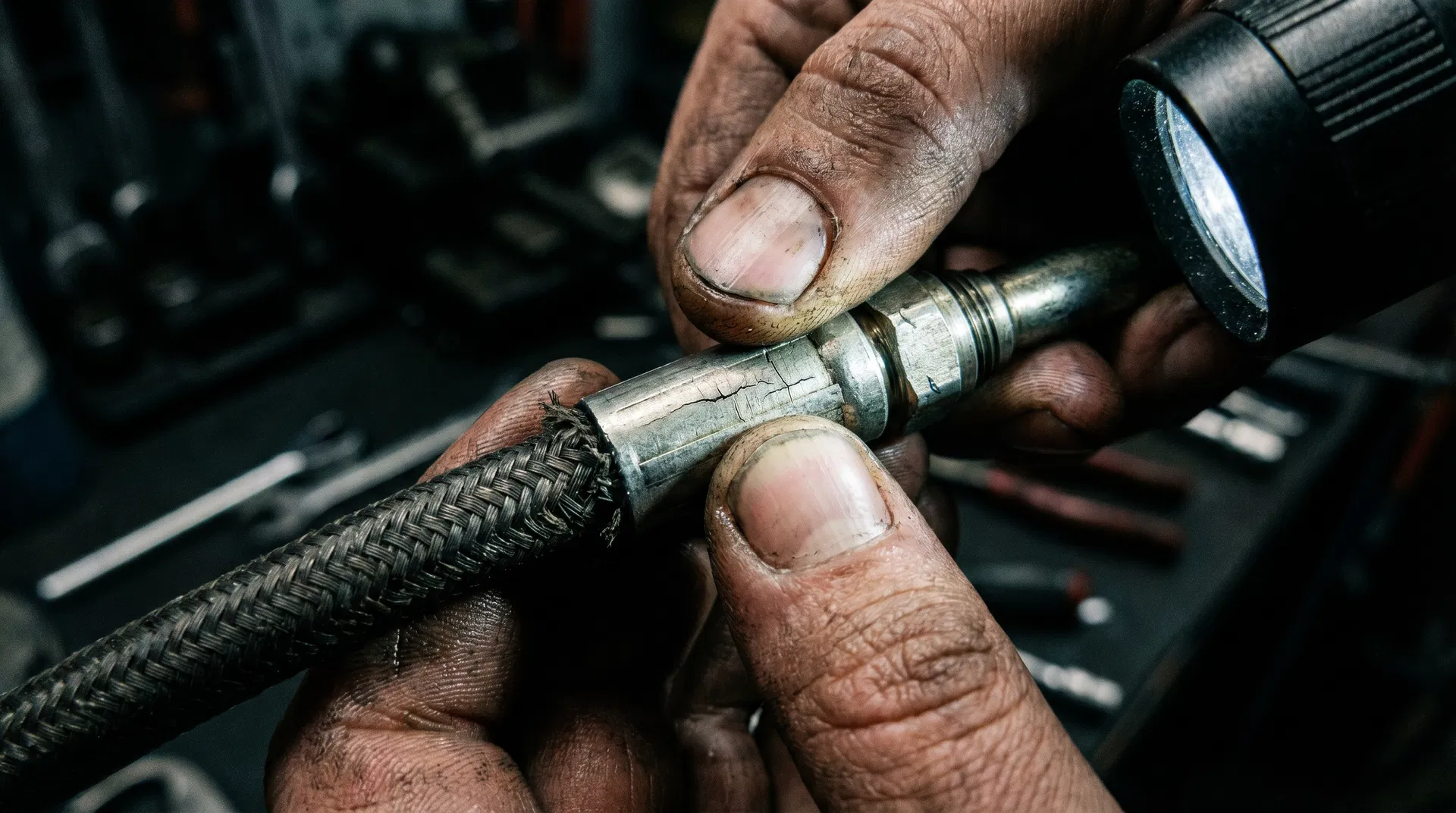
Regular hose inspection should look for several specific conditions: abrasion damage where hoses contact machine structure or other hoses; kinking or bending radius violations that stress the hose reinforcement; swelling or bubbling of the outer cover that indicates internal degradation; and corrosion or damage at the fittings. Any hose showing these conditions should be replaced before it fails, not after.
Age is also a factor. Most hydraulic hose manufacturers recommend replacement at six years of service, regardless of visual condition. The internal reinforcement of a hydraulic hose degrades over time in ways that are not visible from the outside, and a hose that looks fine may be approaching the end of its safe service life.
Cylinder Rod Seals: The Canary in the Coal Mine
A weeping cylinder rod seal is one of the most common hydraulic maintenance items, and it is also one of the best early warning signs of a developing problem. A small amount of oil film on a cylinder rod is normal and actually beneficial — it lubricates the rod seal and extends its life. A cylinder that is actively dripping or leaving oil puddles on the ground is telling you that the rod seal has failed and needs to be replaced.
The temptation to defer a leaking cylinder rod seal is understandable — the machine is still working, the leak is slow, and the repair requires pulling the cylinder. But a leaking rod seal that is allowed to progress will eventually allow contamination into the cylinder, score the rod, and turn a $300 seal replacement into a $2,000 cylinder rebuild. The canary is telling you something. It is worth listening.
Building the Preventive Maintenance Conversation
For shops, the preventive maintenance conversation is also a business development conversation. A customer who brings a machine in for a hydraulic pump failure is a customer who has already paid the price of deferred maintenance. A customer who brings a machine in for a scheduled fluid analysis and filter service is a customer who is managing their equipment costs proactively — and who is likely to be a better long-term customer.
The shops that are best at building preventive maintenance relationships are the ones that make the conversation easy. They have a simple PM schedule that they can walk a customer through in five minutes. They follow up after PM services to check in on the machine. And they track the maintenance history of the machines they service, so that when a customer calls with a problem, they can look at the history and say: the last time we changed your hydraulic filter was eight months ago, and you have probably put 600 hours on the machine since then — let's start there.
Tags
Ready to take control of your AR?
Start your free trial and see how Talox automates collections, syncs your platforms, and keeps cash flowing.
Get the next article in your inbox
Join shop owners and mechanics who get Talox industry insights, data reports, and field guides — no sales pitches, just the good stuff.
No spam. Unsubscribe anytime.
More in Technology
Wrench Meets Wi-Fi: The Diagnostic Tools Heavy Equipment Mechanics Are Actually Using in 2026
5 min read
The Computer in the Cab: How New Technology Is Changing What It Means to Be a Heavy Equipment Mechanic
5 min read

Bluelight's Retrofit Autonomy Kit: When Your Customer's Existing Machine Gets an Upgrade
2 min read