The Real Cost of Downtime: What the Data Says About Equipment Availability and Shop Profitability
A machine sitting idle on a job site is not just a maintenance problem — it is a financial event. Understanding the true cost of downtime changes how shops and operators think about preventive maintenance, parts stocking, and response time.
Vero Intelligence
Powered by Talox Data
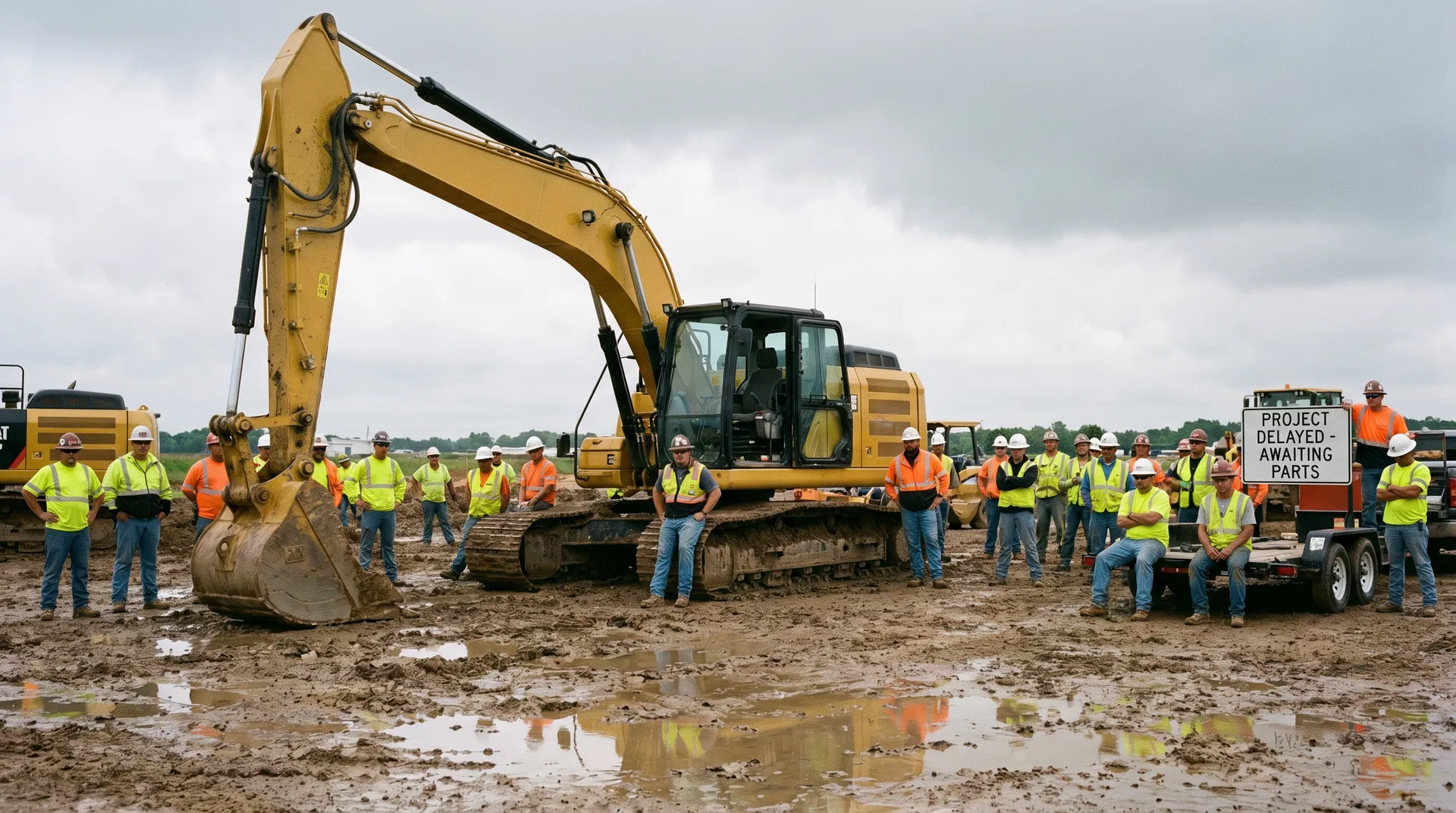
The Real Cost of Downtime
The invoice for a hydraulic pump replacement on a mid-size excavator might read $4,500 in parts and labor. That number is real, and it is the number that shows up on the repair order and in the shop's revenue. But it is not the number that matters most to the contractor whose machine was down for three days waiting for the repair.
The number that matters to the contractor is the cost of three days of lost production. On a machine that bills $1,800 per day in rental equivalent value — a reasonable figure for a 20-ton excavator — three days of downtime represents $5,400 in lost revenue opportunity. Add the cost of the operator who was paid but not productive, the cost of the project delay, and the potential liquidated damages if the downtime pushed the project past a contractual milestone, and the real cost of that hydraulic pump failure can easily exceed $15,000 to $20,000.
This is the number that shapes how the best contractors and fleet operators think about maintenance. They are not trying to minimize repair costs. They are trying to minimize total cost of ownership — and downtime is the biggest single component of that cost.
The Availability Equation
Machine availability — the percentage of scheduled operating time that a machine is actually available for work — is the metric that matters most in fleet management. Industry benchmarks suggest that a well-maintained piece of heavy equipment should achieve 85 to 90 percent availability. That means, out of every 100 hours of scheduled operation, 85 to 90 hours are productive and 10 to 15 hours are lost to planned and unplanned maintenance.
Shops that are below 80 percent availability are leaving significant money on the table. The difference between 80 percent and 90 percent availability on a fleet of ten machines, each operating 2,000 hours per year, is 2,000 hours of additional productive time — at $1,800 per machine-day, that is roughly $450,000 in additional revenue capacity for the contractor.
The shops that help their customers achieve high availability are not just doing good maintenance work. They are delivering a business result that their customers can measure and value.
What Drives Unplanned Downtime
The data on unplanned downtime in heavy equipment is consistent across multiple industry studies. Hydraulic system failures are the leading cause, accounting for 35 to 45 percent of unplanned downtime events. Engine and drivetrain failures account for another 20 to 25 percent. Electrical system failures — increasingly common as machines become more electronically complex — account for 15 to 20 percent. The remaining downtime is distributed across undercarriage failures, structural damage, and operator-caused incidents.
The important observation is that the majority of unplanned downtime events are, in principle, preventable. Hydraulic failures are largely driven by contamination and deferred maintenance. Engine failures are largely driven by lubrication neglect and deferred service. Electrical failures are often driven by deferred inspection and the failure to address early warning signs.
This does not mean that all unplanned downtime can be eliminated — equipment fails in ways that are genuinely unpredictable. But it does mean that a systematic preventive maintenance program, executed consistently, can reduce unplanned downtime by 30 to 50 percent compared to a reactive maintenance approach.
The Response Time Variable
For the downtime that does occur, the variable that most affects the total cost is response time. A machine that is down for four hours because the shop responded quickly and had the necessary parts in stock costs far less than a machine that is down for four days because the shop was backlogged and had to order parts.
This is where the relationship between the shop and the contractor matters most. A contractor who has a strong relationship with their repair shop — who has established themselves as a priority customer, who has communicated clearly about their fleet and their uptime requirements — is going to get a faster response when something goes wrong than a contractor who calls the shop for the first time when they have a breakdown.
The shops that are best at emergency response have thought carefully about what it takes to be able to respond quickly: technician availability, parts inventory, diagnostic equipment, and the communication systems that allow them to triage a problem over the phone and show up with the right parts and tools.
The Preventive Maintenance ROI
The return on investment for preventive maintenance is one of the most well-documented relationships in the heavy equipment industry. Studies consistently show that every dollar spent on preventive maintenance saves between $3 and $5 in reactive repair costs, when downtime costs are included in the calculation.
For a fleet of ten machines spending $50,000 per year on preventive maintenance, that implies $150,000 to $250,000 in avoided reactive repair and downtime costs. The math is compelling — but it requires the discipline to spend the money on maintenance before the failure occurs, which is psychologically difficult when the machine is running fine and there are other demands on the budget.
The shops that have the most success selling preventive maintenance programs to their customers are the ones that can make this math concrete and specific. Not 'preventive maintenance saves money in the long run' — but 'based on the service history of your excavator, here is what we expect to find at the 2,000-hour service, here is what it will cost to address it now, and here is what it will cost if we wait until it fails.' That conversation, grounded in data and delivered with specificity, is far more persuasive than a general argument for preventive maintenance.
Tags
Ready to take control of your AR?
Start your free trial and see how Talox automates collections, syncs your platforms, and keeps cash flowing.
Get the next article in your inbox
Join shop owners and mechanics who get Talox industry insights, data reports, and field guides — no sales pitches, just the good stuff.
No spam. Unsubscribe anytime.
More in Market Analysis
Q1 2026 State of Heavy Equipment Repair: A Vero Intelligence Report
18 min read

What the Numbers Say: Vero's First Look at AR Collections Patterns Across Heavy Equipment Repair
7 min read

Georgia's $26 Billion Building Boom: What It Means for Heavy Equipment Repair Shops
8 min read